


Women in the technology field – and deep tech in particular – face higher risk of job displacement due to AI and automation, according to a recent City of London Corporation report. This comes as a warning as Europe grapples with a persistent gender gap in the field.
In 2022, women accounted for almost one-third of the total number of employees in the EU’s high-tech sphere. This pattern is visible in the academic field as well: in the same year, only 17.9% of full professorships in engineering and technology were held by women.
Europe’s gender imbalance in tech persists
Although women represent 40.98% of all scientists and engineers in the broad “science and tech” category, their representation drops sharply in the more technical STEM fields, according to GENDEX, Europe’s first gender and diversity index.
To tackle this issue, the European Commission has proposed that by 2030, at least 40% of tertiary STEM students should be women. But, in 2025, women made up only one in three STEM graduates, one in five information and communication technology (ICT) specialists, and 24% of self-employed technicians in science, engineering and ICT.
These gaps result from various factors, such as family and school, with girls often lacking confidence in their abilities in maths and science, leading to low expectations in STEM careers.
Zooming in on individual EU member states reveals a similar pattern: in the Netherlands, for example, the share of female STEM graduates rose from 28% in 2016 to 33% in 2022, although in innovation hubs, the gender gap remains stark. At the High Tech Campus Eindhoven, women made up just 20% of the tech workforce in 2018.
Beyond statistics, the imbalance has affected everyday working life. Many women report feeling isolated, misunderstood, or pushed to consider leaving their fields altogether.
In response, Ingelou Stol, co-founder of Fe+Male Tech Heroes, and her partner Hilde de Vocht, launched what was meant to be a one-time meet-up for women working on the High Tech Campus – a space to connect, share experiences, and feel less lonely.
“In a few days all tickets were booked,” Stol told 150sec about the first edition in 2018.
Beyond visibility, towards systemic change
Stol’s first meetup hosted 300 people from across the tech industry, and, what began as a single gathering, has since grown into Fe+Male Tech Heroes, a thriving community aiming to bring visibility to women in the tech field.
Last year, the community had grown to have over 5,000 ambassadors and partnerships with more than 25 organisations, including Philips and ASML, alongside smaller scale-ups and start-ups.
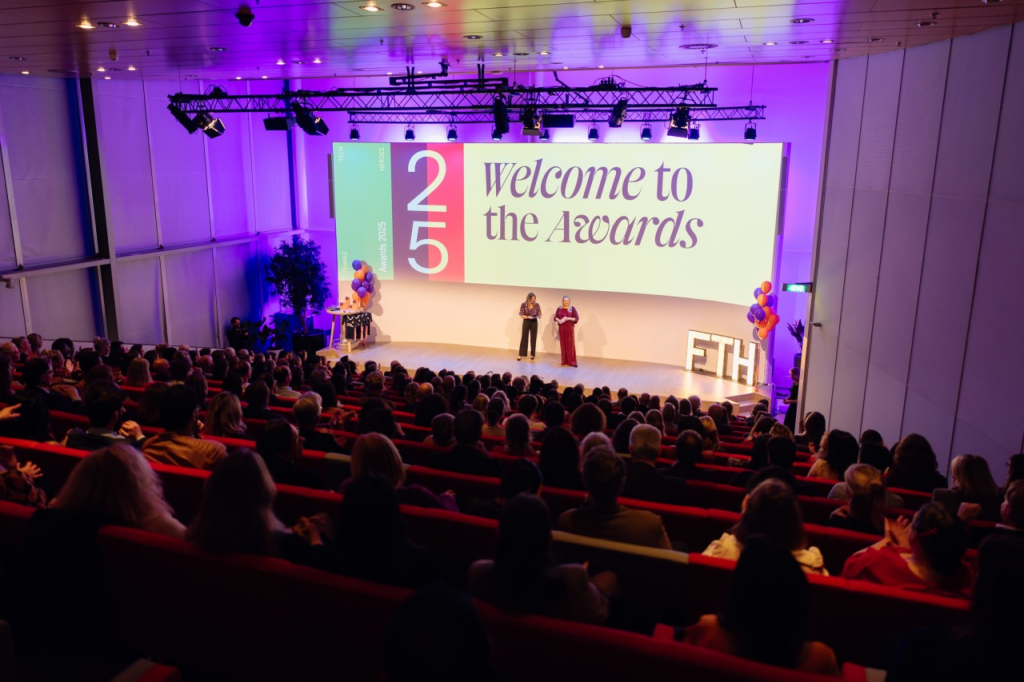
Fe+Male Tech Heroes aims to amplify women as role models not only on stage while at their events – including an annual conference, awards, dinners, and monthly meetups – but also by leveraging digital platforms like Instagram and LinkedIn.
Female role models, particularly in fields such as ICT, can help address gender gaps by challenging stereotypes and fostering a more inclusive environment.
Speakers at the events have included prominent figures such as cardiologist Angela Maas, known for her work on gender differences in heart disease, and Renee Malone, a neuropsychologist specializing in neurodiversity and neuroinclusion in the workplace.
For Stow, visibility is only part of the mission. A lack of diversity in tech can lead to biased innovation, with real-world consequences.
“We are evolving as a community and we realized that in order to make a change, we have to work together,” she said, pointing to car safety systems that are less effective for women. Female drivers, for instance, face a 73% higher risk of being seriously injured in frontal car accidents due to testing standards based primarily on male body types.
The goal to bring more women to the spotlight isn’t just about diversity in the fields themselves; it is also about making future technologies related to biomedical and AI innovations, among others, more inclusive and less biased.
Connecting with allies
As the Fe+Male Tech Heroes community matured, new questions emerged. Recognizing that systemic change requires collaboration, the platform began to actively engage with men as allies; hence, the “+” in its name.
“We are evolving as a community and we realized that in order to make a change, we have to work together,” Stol noted. A separate event was then organized, focused on men and emphasizing what it means to be a male ally for women despite representation and participation gaps.
While the community is built around women for women, Stol said that there “are allies of all genders.”
Technology, she added, should not be intimidating. “We’re living in a world where technology intertwines with many things, and it is amazing to be part of it. With what we do, and bringing role models to the forefront, we can show these people that they can have [an] impact on society.”
“It is important to find like-minded people and learn what the industry means for you,” Stol concluded.
Community for the automated age
In 2026, this community-building has perhaps never been as pressing. Even in economies like the EU’s, which have turned to regulatory measures with new technologies like artificial intelligence (AI), women working in tech and finance are at higher risk of losing their jobs due to the increased use of automation.
Regardless, Stephany Oliveros, co-founder and CEO of women-focused AI learning platform SheAI, noted that the real divide isn’t gender, but rather opportunity.
“When the narrative becomes ‘women are slower to adopt AI.’ we flatten a complex issue into a gender binary and lose sight of the deeper question: who is being left behind entirely?” Oliveros stressed.
“What if, instead [of treating innovation as a race with gendered lanes], we focused on creating spaces of integration that are for everyone? Not just women. Not just men. But people from different geographies, different economic realities, and different lived experiences. Because the future of AI, the future of humanity, shouldn’t be defined by a handful of tech giants and venture capitalists in Silicon Valley. It should be shaped by all of us.”
Beyond the burdens faced by mid-career women, who have at least five years’ experience – which include being overlooked for digital roles – new female hiring prospects are also being sidelined as a result of rigid hiring processes. AI will undoubtedly continue to become embedded across industries, markets and geographies. Sectors’ response – or lack thereof – will go beyond economic volatility, talent acquisition or retention: it’s also about equality in opportunities, community and women’s place in the new age.
Featured image: Courtesy of Fe+Male Tech Heroes
Disclosure: This article mentions a client of an Espacio portfolio company.