



Dosty Walks has signed up 1,600 users in weeks, aiming to convert footsteps into 7,000kg of donated food this year.
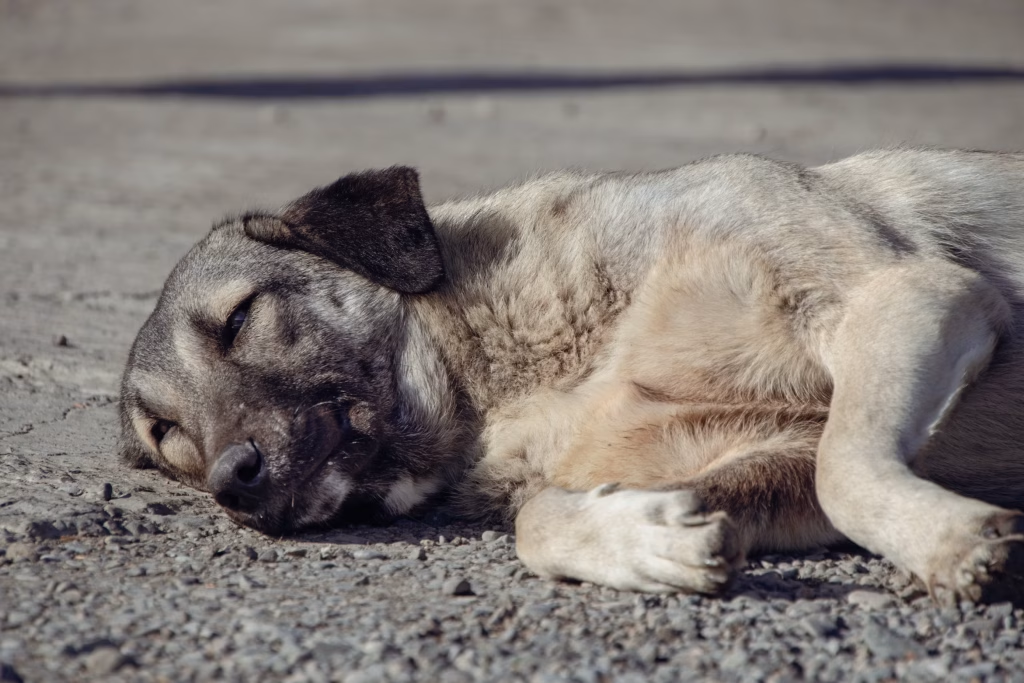
Most dogs alive today never see the inside of a home. An estimated 75% of the world’s roughly 900 million dogs are strays, and the shelters that exist to help them are usually one missed donation away from running out of food – the single largest line item on any shelter’s budget, and the first thing cut when money is tight.
Azerbaijani pet-care platform Dosty, however, has found a low-friction fix: turn the walk people are already taking – with or without pets – into shelter donations.
Dosty Walks, launched in June 2026, converts steps into in-app coins – 1,000 steps per coin, 1,000 coins per kilogram of food donated to a partner shelter. No purchase, donation, or pet ownership required.
“You don’t need any extra effort,” founder Ayaz Ahmadov told 150sec. “You can donate your steps and somebody is going to get food.”
Early traction
The numbers, for a market this size, are notable: the initiative has pulled in more than 1,600 registered users in Azerbaijan in its first weeks, and the platform is projecting over 1,500kg of food donated to shelter partners by the time Season 1 wraps in August.
The app runs on three-month “seasons,” each with its own theme, progression map, leaderboard, and milestone rewards from partners. Season 1 is anchored in Baku with United Coffee Beans, Park Cinema, and vet clinics BelVet and Alfavet on board as local partners.
A $2 USD monthly subscription unlocks partner discounts that, Ahmadov says, are structured to exceed the subscription cost, meaning even users who don’t prioritize the wider animal welfare cause have no financial reason to opt out.
That’s by design. Ahmadov built the product for three overlapping user types: people already motivated by animal welfare, leaderboard-driven “competitive junkies,” and subscribers chasing the discounts. “While they’re competing, they may as well do the donation,” he said. “Why not?”
The platform is projecting over 1,500kg of food donated to shelter partners by the time Season 1 wraps in August.
The trust problem
Communal shelter fundraising has a transparency issue: money gets pooled but what happens to it afterward is often opaque, a problem researchers tracking nonprofit donor trust have flagged for years.
Dosty’s structure sidesteps that hurdle. Food delivery is guaranteed by the company itself regardless of whether community donations hit a given threshold, and users get photo and video proof of each delivery.
In fact, community coins add to that baseline rather than enabling it.
Dosty’s Year 1 commitment is 7,000kg of food delivered in Azerbaijan. And while it currently supports 60 dogs directly it is targeting 150 by the end of 2026 – roughly a quarter of the country’s 600 officially sheltered animals.
Next up: Latin America
Ahmadov has already picked the platform’s next market, and it isn’t an obvious adjacency. Latin America, led by Mexico and Venezuela, is the priority for H2 2026, a call he ties partly to regulatory shifts like Colombia’s reclassification of pets as sentient beings rather than property.
“I can live in Azerbaijan but walk for dogs in Medellín. That unification factor is where the magic happens,” Ahmadov said.
The U.S., UK, Romania, Poland, and Australia are next on the list, chosen for pet-ownership density, regulatory tailwinds, and partner potential.
Longer-term, however, Ahmadov is positioning Dosty Walks as a CSR channel – a way for brands, insurers, and telcos to fund shelter feeding with built-in accountability, riding on Dosty’s existing base of 55,000 downloads and 46,000 pet profiles across over 50 countries.
Dosty is actively seeking local partners – shelters, brands, and civic organizations – to launch future seasons of Dosty Walks. Founders of companies interested in bringing the platform to their region can send an email to [email protected].
Featured image: Tatiana Mokhova via Unsplash+

Disclosure: This article mentions clients of an Espacio portfolio company.