



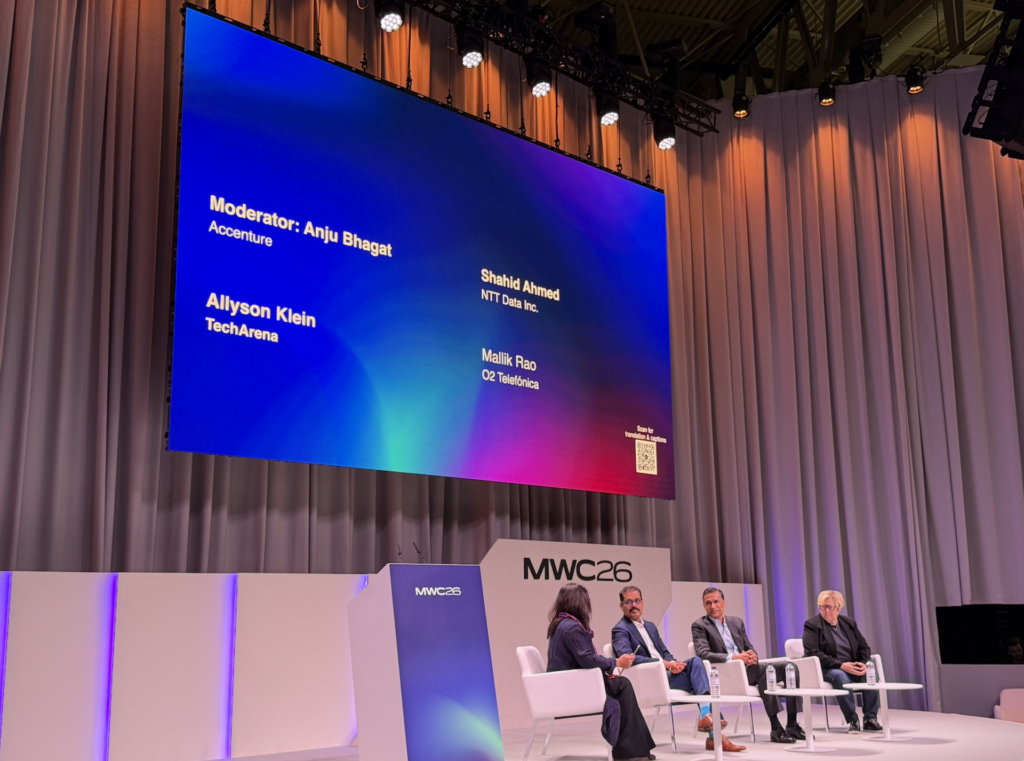
Senior executives from NTT Data, Accenture, and Telefonica Deutschland joined TechArena Principal Allyson Klein on March 2, 2026 during annual global technology conference MWC Barcelona to discuss how enterprises are rewiring their operating models in the face of AI.
“AI is not the answer; it’s an enabler. It’s a powerful catalyst and accelerator on how operators – on both the consumer and the enterprise side – can transform their business,” Brian Shepherd, CEO at global tech provider CSG, noted during a keynote presentation prior to the roundtable.
In this context, European telecommunications companies (telcos) have never had more to lose – or to gain. According to the Mobile Economy Europe 2025 report by the Groupe Speciale Mobile Association (GSMA), 5G adoption in the region through 2030 will boost the economy by €164 billion.
The technology, in fact, already accounts for the majority of connections in Germany and Switzerland, with adoption rates in Denmark, Finland, Norway and the UK exceeding 40%.
Yet, Europe lags behind North America, East Asia and the Gulf Cooperation Council states, partly due to regulatory challenges. As per GSMA, 5G will reach 95% connectivity in the Gulf states and South Korea, and 94% in the U.S. by 2030; both the EU27 and the wider European region lag behind, with 80% connectivity predicted for the same time period.
In the past year, telcos stakeholders have invested in networks while seeking to fill this gap in an industry that represents 5% of Europe’s GDP. In the EU specifically, the digital economy relies heavily on investments by telcos to keep the Union at the forefront of digital innovation and connectivity.
Meanwhile, AI has also risen to the challenge, with European telcos leveraging the technology to improve their infrastructure, data management, insights, applications and professional services. According to a February report by Mckinsey, agentic AI poses becoming a full-scale execution tool that can “fundamentally change how telcos design operations, deploy capital and create value.”
“I think the telcos sector is ripe for major disruption relative to AI. The old, monolithic OSS [Operations Support Systems] and BSS [Business Support Systems] – everything from provisioning, activation and billing – could be unified into one single frontier model that enables workflows,” noted Shahid Ahmed, Global Head of EDGE Services at NTT Data.
“We have thousands of people in a single telco managing those systems, and, to me, that allows a telco not only to become more agile in all kinds of disruptions that we’re seeing, but also be able to provide superior customer experience.”
From monoliths to models
OSS and BSS have long been considered rigid, back-office platforms; as long as customers could be billed, installments completed and reports produced, these systems were good enough. Inefficiencies, in this sense, were accepted as part of operating a telco.
However, legacy system maintenance costs organizations as much as 80% of their IT budget – leaving little room for innovation. Meanwhile, the divide between leading and lagging firms persists: those which leverage AI-enabled data and digital fluency, and those that do not.
Regardless, telcos have become agile and intelligent drivers of digital transformation through their use of AI and cloud computing. Since 2017, European institutions have intensified their AI work, fostering development while ensuring that ethics and rights remain at the forefront – especially through compliance with EU AI Act. Now, AI is being deployed for real-time network performance monitoring, predicting failures before they occur, and rebalancing capacity during traffic peaks.
“Intelligence is moving from core to the edge. From an IoT perspective, everything that’s going to happen on the AI side will be at the edge. And we all know this; GPU costs are going to be skyrocketing for any IoT use case […] so you have to bring that cost down. And in order to do that, we need smaller language models, smaller AI models, math-based, physics-based – as opposed to language-based,” stressed Ahmed.
Telco leaders have already harnessed AI. As they continue to do so, it will become all the more evident that fostering the technology’s true potential requires sustained, long-term commitment – including C-Suite sponsorship, disciplined organizational transformation and change management.
However, 57% of telco executives report scaling use cases have remained unchanged in the past year, as per McKinsey. Yet, more than three-quarters of those surveyed by the consulting firm agree that immature operating models, data limitations, and lagging adoption due to ineffective change management are top priorities.
Despite agentic AI posing great potential for telco leaders to capture value, as it is predicted to create $16 billion USD in new economic value for the U.S. sector alone, AI islands – disconnected models that solve niche challenges – and data fragmentation remain barriers to connected intelligence.
Inside a telco, these nuances instill chaos and foster a pilot purgatory problem – whereby firms struggle to adopt emerging technologies at scale.
“The one most important thing we realized was that, irrespective of where data is sitting, whether LLM or SLM, you can democratize access – and that is the power of AI. What I started seeing: I don’t need to consolidate, it can be federated. You just need to know data residency,” Mallik Rao, Telefonica Deutschland Chief Technology and Enterprise Business Officer, explained.
“Do you have an owner, a function or a person, who owns the data? That was the most difficult task for us; we have 26 different data lakes, maybe nine people who could say ‘I own the data’ – the rest is generated,” he added.
“The thing that we need to do is look at this distributed sense of enterprise working on AI and different pilots […] We’ve got endless pilots; getting scale is hard,” concluded Klein.
The question of governance
The urgency is as much financial as it is technological. In Europe, the structural squeeze faced by telcos has been compounded by a paradox: demand is soaring, but revenues are not. Against this backdrop, AI becomes an economic necessity; the technology alone could drive incremental EBITDA margin gains of 3-4% within two years, and as much as 8-10% in five, as per McKinsey.
Yet, deploying isolated tools will not be enough to realize financial gains; only a third of telco executives surveyed by the consulting firm last year expected investment capital growth to accelerate over the next three to five years, representing a 50% decline from the 2024 outlook.
“Telcos have been doing everything on the edge, and so this is a big opportunity where they could leverage their own capabilities and be out there,” added Ahmed.
AI is thus not a new toolset, but rather an enterprise operating system change – which is harder than simple system swaps, as Rao pointed out. Hardship is structural: inside a single European telco, data is scattered throughout dozens of lakes, owned by different functions, governed by different teams, and increasingly subject to cross-border residency rules that vary based on jurisdiction.
Moving quickly enough to capture AI’s financial upside while safeguarding the rigor that regulators and customers demand in the region is, for many, the central tension now.
The AI Act, as the world’s most comprehensive legal framework for the technology, makes it so that compliance is not optional and obligations significant: transparency, risk classifications, and strict rules surrounding the convergence of automated decision-making and consumers.
Where American hyperscalers and Gulf operators can move with relative speed, Europe must build governance into systems’ architecture from day zero.
Regardless, they have a competitive advantage. “Normally, we say the moment AI comes in, governance is a beast. But, after two years of working through different LLMs and asking how you really land this technology, governance plays a significant role – because we work with the trust of consumer data,” said Rao.
European telcos sit on some of the global economy’s most sensitive data: location, behavior, communication patterns and financial transactions. Under financial pressure, the temptation thus becomes treating such data as a purely commercial asset.
A smarter play, which many telcos already tried their hand at, is assuming the responsibility that the European landscape encourages – which translates into a differentiator: “You cannot afford to make a mistake or take it for granted. The data is the customer, and the data is the product. Those are the two advantages that, for me, are pretty revealing,” said Rao.
Economics, sovereignty and physical AI
If governance is the internal reckoning, the economy rises as the external pressure – making inaction impossible.
Europe’s telcos are caught in a structural bind that no amount of operational efficiency alone can resolve: the cost of maintaining legacy infrastructure continues to rise, while the 5G promise remains not self-executing. Capturing current potential requires a rethinking of how telcos are built, and where exactly their intelligence lives.
“We’ve talked about the GPU cost, but then there’s the cost of moving data; storing data. Every single element of computing platforms is being accelerated at a faster pace. We’re living in a much more heterogeneous world, meaning that management of this infrastructure becomes harder and we have to make the right choices,” said Klein.
For many operators, the answer is physically closer than it appears. Most users sit within 500 to 600 meters of a telco infrastructure node – a ready-made edge fabric that, if operators can run AI on it safely, transforms legacy assets into a life intelligence layer.
The war in Ukraine made this energy shock more concrete. “When the energy price shut down four times in a single day, it made us compelled to say AI has to be scaling in many access networks to manage energy,” noted Rao. AI at the network edge thus became a tool for energy optimization, not just traffic management.
The next frontier for telcos is not abstract. It is the factory floor where a sensor catches a fault before a worker does, the hospital corridor where a robot navigates around a nurse, the motorway where a vehicle responds to conditions its driver has not seen yet. Private 5G and edge computing makes this not only possible, but urgent. And telcos, more than any other industry, own the infrastructure it runs on.
“We’ve seen many reincarnations from edge AI to physical AI. To me, that’s a huge opportunity for telcos to play a major role, and I think above and beyond just being a network provider – providing everything from private 5G and 6G,” said Ahmed.
This is where sovereignty becomes a matter of frame. The convergence of 5G, edge computing and real-world automation powering robots, sensors and vehicles will collide with a new generation of regulation: kinetic safety rules, sovereignty concerns, and governance frameworks that don’t yet exist.
Getting ahead of that collision, instead of reacting to it, is the strategic task. “Sovereignty doesn’t mean that we want to be independent or disconnected. I still fundamentally believe that it’s the freedom to choose,” said Rao.
Don’t go it alone
Ultimately, the ecosystem is not vendor-based, and no telco can do it alone.
“I think it’s always been a partnership model, whether you’re a supplier or a partner. In the world of AI, you absolutely need to have a partnership strategy, there’s no doubt about it. You shouldn’t be building your own LLM…build your own frontier telco model,” said Ahmed.
The smarter architect builds on what’s available – like OpenAI or Anthropic – and layers purpose-built SaaS platforms on top, including Salesforce, ServiceNow, and CSG.
Meanwhile, the orchestration starts with abandoning the last vestiges of “telco as utility,” according to Klein. The speed and complexity of AI means operators must lean into deep-tech partnerships and open best-practice sharing, not just transactional relationships.
The necessity is clear: as AI spending accelerates towards the trillions of dollars and regulatory pressure mounts, taking a lonely path is not just expensive, but strategically risky. European telcos that treat AI as a shared infrastructure, partner up and down the stack, stand a better chance of moving from pilots to scaled deployments.
Those that cling to insular build-yourself reflexes may just discover too late that in the age of AI, isolation is just another form of technical debt.
Featured image: Courtesy of Salomé Beyer Vélez.