The next wave of AI innovation lies on women – and on the doors they open for both themselves and others.
As AI systems become more advanced and more deeply embedded across industries, progress increasingly hinges on high-quality, sustainable code, along with the ability to ensure reliability and actively mitigate risks such as bias. Context has become mission critical.
According to Rajat Mishra, CEO of Prezent, in Fast Company, “Without contextual intelligence, even the most advanced generative AI tools fall short in real-world use cases where accuracy and reliability are critical.”
But, as per a May 2025 study, the underrepresentation of women in software engineering raises concerns about homogeneity in AI development. Diverse perspectives, in fact, are essential for improving system robustness, reducing bias, and enhancing overall quality.
SheAI, an edtech startup founded in Barcelona in 2024, was born from a seemingly simple, yet complex mission: bridge the gender gap in AI by empowering women and providing accessible, high-quality AI education.
The company is a partner of the United Nations AI for Good Skills Coalition, and, as the first platform in the world that focuses exclusively on AI training for women in every industry, its upcoming beginner-friendly “From Idea to Income in 4 weeks” bootcamp will offer a helping hand to aspiring women entrepreneurs who wish to connect, learn and apply AI to advance their careers and businesses – starting January 28, 2026.
The AI revolution, and the risk of leaving women behind
Since OpenAI first released ChatGPT in November 2022, generative AI has made its way into every corner of our lives with astonishing speed. AI has become all-pervasive, used as everything from personal agony aunt to instantly debugging thousands of lines of code. Platforms like ChatGPT, Google’s Gemini and Anthropic’s Claude now process billions of prompts per day.
The rapid mainstream adoption of the technology follows an all too familiar pattern: early experimentation and innovation is dominated by men while women hold back.
Kristina Talova, Stephany Oliveros, and Maja Zavrsnik, SheAI founders, believe that without support, women risk being left behind in an AI-driven economy.
Confidence and caution in early AI adoption
When ChatGPT first launched, early user data showed that around 80% of users were men. Usage has since become more balanced over time, but an unfortunate pattern remains: as with other technological breakthroughs, women take longer to engage. And, with AI, research shows women are adopting it at 25% lower rate than men.
For many, this hesitation is not the result of lacking ability. Rather, it’s about lack of confidence.
Women often feel they need to understand all the ins and outs of a system before using it, or are put off by ethical concerns in a global workforce that demands they be moral and ethical beacons.
The stakes are high: women are already at greater risk of losing their jobs to automation, and some experts warn that biases in AI recruitment tools could widen existing gender gaps in the labour market.
“In professional environments, AI that is almost good enough is often not acceptable, because small contextual errors can undermine trust and reinforce existing inequalities,” said Mishra.
How can women regain their footing?
SheAI’s founders noticed the AI gender gap early. At their women-only coworking space, they were surrounded by passionate professionals who were curious about the technology, but hesitant to dive in. They kept hearing the same concerns:
I’m not confident or tech-savvy enough to research on my own.
I’m worried about ethics.
I don’t even know where to start.
I just don’t have the time to invest in learning more about AI.
These doubts stood in sharp contrast to the men they knew, who were proactive about learning, confident enough to experiment, and less concerned about ethical considerations.
Nobody is ever ready
The advice of SheAI founders is refreshingly candid: don’t wait until a technology feels “safe”, or until a business plan is flawless. Instead, be disciplined in your approach, find a support network, and take heart in the simple truth that nobody – not women or men – is ever ready.
Confidence and career growth are built through practice, and diving in headfirst. The most effective entrepreneurs often act without feeling fully prepared, receive criticism with open arms, and have the resilience to adapt and respond to feedback.
Beyond that, AI-powered startups allow entrepreneurs to do more, with less. Experts argue we are now entering the “Tiny Team” era, where AI agents work alongside small human teams of just two to ten people, enabling founders to build and scale thriving businesses with only a handful of employees.
“AI only delivers real value when it supports informed human decision-making, rather than generic automation detached from real workflows,” said Mishra.
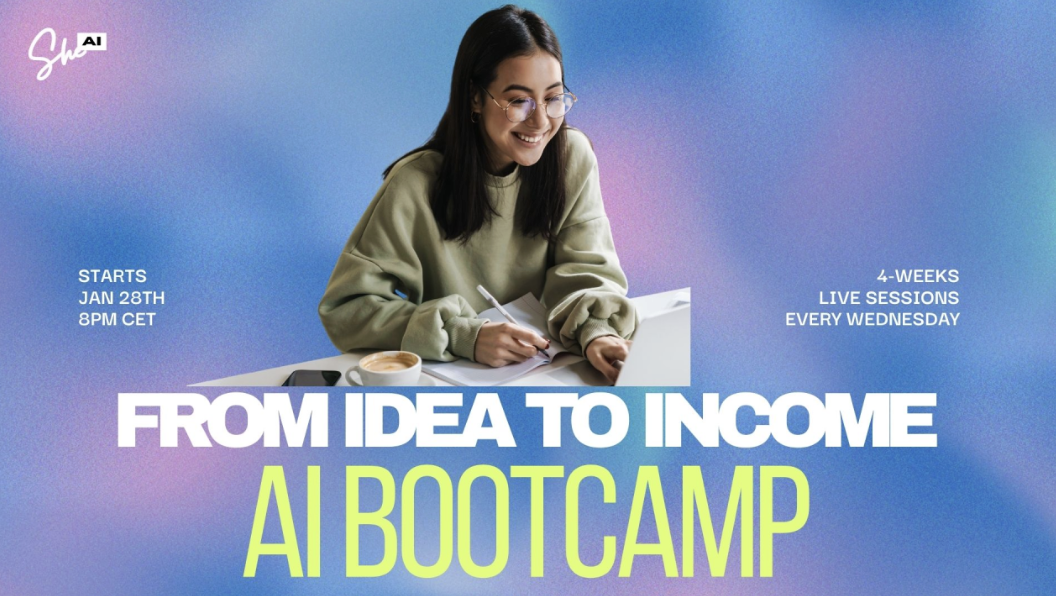
The SheAI bootcamp will give women the opportunity to build a Tiny Team startup of their own. In four short weeks, participants will turn their business idea into an action plan, learn how to integrate AI tools, and leave with a live website, their own team of AI assistants, and a ready-to-go newsletter.
AI with a more human touch
When women do step into AI creation, outcomes often look very different to those of their male counterparts. A 2025 empirical study, for instance, found that female contributors’ code demonstrated consistently higher quality than their male peers, although they contributed a smaller proportion of total code.
Similarly, at SheAI’s workshops and the recent Vibe Coding Buildathon, an overwhelming majority of business ideas centered on community, care, and wellbeing — including tools for postpartum fitness, healthcare training platforms, funding access for entrepreneurs, and organisation apps for mothers.
While much of the current discourse surrounding AI focuses on concerns about surveillance, bias, environmental impact, and exploitative business models, the women-led AI projects developed at SheAI offer an alternative: technology designed to support communities.
Shaping the future by turning ideas into businesses
As women step into AI not as late adopters but as intentional builders, the technology itself has the potential to change. On the flipside, women who can harness the power of AI for their business also have everything to gain.
SheAI’s upcoming “From Idea to Income in 4 Weeks” bootcamp offers a concrete step towards a more equitable and accessible future for women in an AI age.
“We’re building a space where women support each other – not just through online courses, but through real connection […] It’s not about learning once and leaving; it’s about constant guidance and growth together,” SheAI co-founder and COO Kristina Talova told 150sec last year.
The fact is, AI is here to stay. Moving towards a future with ethical AI isn’t just about regulation — it’s about who builds the tools, and what they are used for.
The future lies with those who step up, and women who take the leap into AI today are shaping the businesses of tomorrow.
Featured image source: Getty Images via Unsplash+

Disclosure: This article mentions clients of an Espacio portfolio company.