

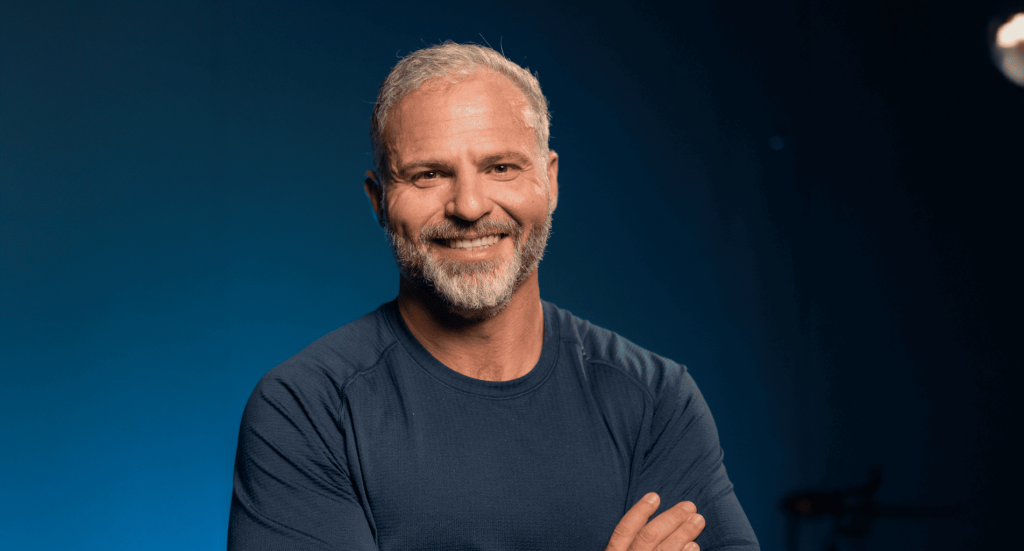
When Vic Pellicano looks at the rise of robotics, he does not see a future where machines simply take blue-collar jobs.
He sees a chance to create more business owners.
That is the idea behind SkyPSI, a technology company launching in Dallas-Fort Worth with $5 million of Pellicano’s own money. The company is using commercial cleaning drones as the starting point for a broader proposition: give independent operators access not only to robots, but also to the training, certification and contracts required to turn the technology into a business.
The concept comes from Pellicano’s own experience with technology and entrepreneurship.
The son of a truck driver, Pellicano grew up in a trailer park outside Chicago. After losing both of his parents, he experienced homelessness and lived out of his car. He eventually rebuilt his career, using his computer science and mathematics background to launch technology companies.
His first company, Verenia, was acquired by Oracle in 2022. He later founded AI drone company Avianna, which was sold in 2024.
SkyPSI is his attempt to apply that experience to a different kind of entrepreneur.
“Some think the robot economy belongs to people with the right badge and the right zip code,” Pellicano said. “I think it belongs to the guy who shows up at 5 a.m. with calluses on his hands.”
The missing piece in robotics
Commercial cleaning drones have already been used to wash buildings for years. SkyPSI’s argument is that the technology itself was never the main obstacle.
The missing piece was everything around the machine.
An individual operator interested in entering the industry still needs training, certification, insurance, customers and a way to win commercial contracts. SkyPSI is attempting to package those elements together.
The company provides professional cleaning drones, trains and certifies operators, and connects them with commercial cleaning contracts that SkyPSI has already secured.
The operator remains independent.
They can have their own truck, crew and company, while the drone performs the more dangerous parts of exterior cleaning.
“For working-class people the tradeoff was always the same: you traded your body for a paycheck,” Pellicano said. “Not anymore. The robot takes the risk. You take the contract. And this time your name is on the company.”
It is a different proposition from the usual narrative around automation.
Rather than asking how many workers a robot can replace, SkyPSI is asking what happens when the robot becomes a tool that allows a worker to operate a larger and potentially safer business.
An industry built around risk
Commercial exterior cleaning is particularly suited to that argument because the work can involve significant safety risks.
Workers cleaning tall buildings have traditionally relied on ropes, pulleys and other equipment to reach exterior surfaces. SkyPSI’s drones are operated from the ground by FAA-certified pilots.
The company believes that removing some of the physical risk could also make exterior cleaning economically viable more frequently.
According to SkyPSI, commercial cleaning is on track to become an $860 billion market by 2034, while robots currently account for only about 1% of the industry.
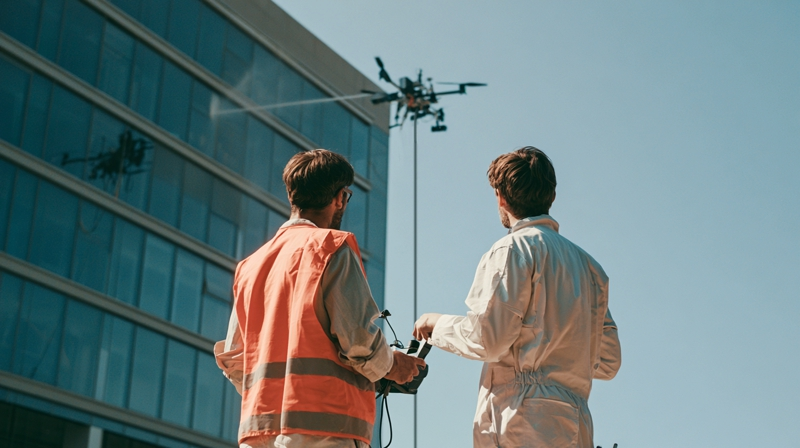
The company argues that automation could expand the market rather than simply reduce its workforce. Buildings that might previously have been cleaned once a year because rope-based work was expensive and dangerous could potentially be cleaned four times a year using drones.
That creates a different economic equation.
The robot is not necessarily replacing the cleaning company. It can become part of the infrastructure that allows a small operator to take on more work.
A bet on the next generation
Pellicano is putting $5 million of his own money into the idea because he sees his own trajectory as evidence that technology can change someone’s economic prospects.
“Tech turned a homeless kid from a trailer park into a multimillionaire,” he said. “I’m putting $5 million of my own money into making sure working people get the same shot. Machines should take the strain. People should take the profit.”
SkyPSI will initially operate across Dallas-Fort Worth and plans to expand through the Texas Triangle before moving into other U.S. cities.
Its target customers include hotels, senior living communities, office buildings, multifamily and HOA communities, medical facilities, parking structures, and retail and mixed-use developments.
For Pellicano, however, the longer-term opportunity is bigger than cleaning.
The company is effectively testing whether physical AI and robotics can be distributed through independent entrepreneurs in the same way that software tools have enabled small businesses to compete with larger companies.
That model depends on more than the robot itself. It requires access to customers, training, operational support and a company willing to stand behind the work.
SkyPSI is betting that if those pieces are put together, automation can become less about eliminating the worker and more about changing what the worker is able to build.
The company’s first product may be a drone-powered cleaning service.
Its bigger experiment is whether robots can help turn workers into owners.