


The European Commission presented its proposal for new rules, dubbed EU Inc., on March 17, 2026, aiming to make the process for businesses to start, operate, and grow across the EU swifter.
EU Inc. is expected to function as an optional harmonised EU framework that allows companies to operate under a single set of rules instead of navigating national systems.
“Today, European entrepreneurs who want to scale up face 27 legal systems and more than 60 national company forms. With EU Inc., we are making it drastically easier to start and grow a business all across Europe,” said Ursula von der Leyen, President of the European Commission.
In a press statement, the Commission argued that such “complexity can delay the setting-up of a company for weeks or even months, slowing growth, raising costs and discouraging scale.”
Against this backdrop, a 2025 report led by economist and former Italian Prime Minister Mario Draghi underscored the need to improve the EU’s competitiveness, also taking into consideration “making it easier for innovative companies to scale up in Europe.”
To tackle these challenges, the Commission proposed a number of regulations that are expected to “provide a single harmonized set of corporate rules” to unlock “the true potential of the Single Market.”
The European Single Market, established in 1993, is an economic area encompassing all 27 members as well as Iceland, Liechtenstein, Norway, and Switzerland. It guarantees free movement of goods, services, capital, and people, allowing for a borderless competitive market.
One of the key rules included in EU Inc. is faster registration of companies – within 48 hours for less than €100, with no minimum share capital requirements.
“Any entrepreneur will be able to create a company within 48 hours, from anywhere in the European Union, and fully online,” noted von der Leyen.
Europe Inc. also aims to simplify procedures such as submitting company information and digitizing corporate operations. In this sense, companies part of EU Inc. would be able to offer EU-wide employee stock option plans and choose the member state in which they operate.
“We are delivering a pragmatic revolution. We are giving reasons for future founders to grow and scale in Europe. We are making things easier for people with good ideas,” added Henna Virkkunen, Executive Vice-President for Tech Sovereignty, Security and Democracy.
Other opportunity features expected to help companies part of the EU Inc. network are access to fully digital liquidation processes and better conditions to attract investments.
“A once-only, fully digital submission process reduces administrative burdens, giving entrepreneurs more time to focus on growing their businesses. Under this new EU corporate legal framework, EU Inc. companies will benefit from simplified governance procedures throughout the lifecycle of the company,” explained Michael McGrath, Commissioner for Democracy, Justice, the Rule of Law and Consumer Protection.
The proposal has to be discussed by the European Parliament and the Council, although the Commission has urged its co-legislators to reach an agreement by the end of 2026.
Industry voices broadly welcomed the initiative.
“The EU Inc. proposal is a positive step. Its success will ultimately depend on whether startups and investors across Europe can trust and actually use the new framework. We’re now counting on the European Parliament and Member States to strengthen it,” said Vasco Pereira da Silva, Head of Policy at Allied for Startups, a global network of developers and startup advocacy organizations working on issues that impact the digital economy.
In a LinkedIn post, EU Science, Research, and Innovation described the proposal as “a key deliverable in EU Startup and Scaleup Strategy – designed to keep Europe’s brightest innovators growing here and competing globally.”
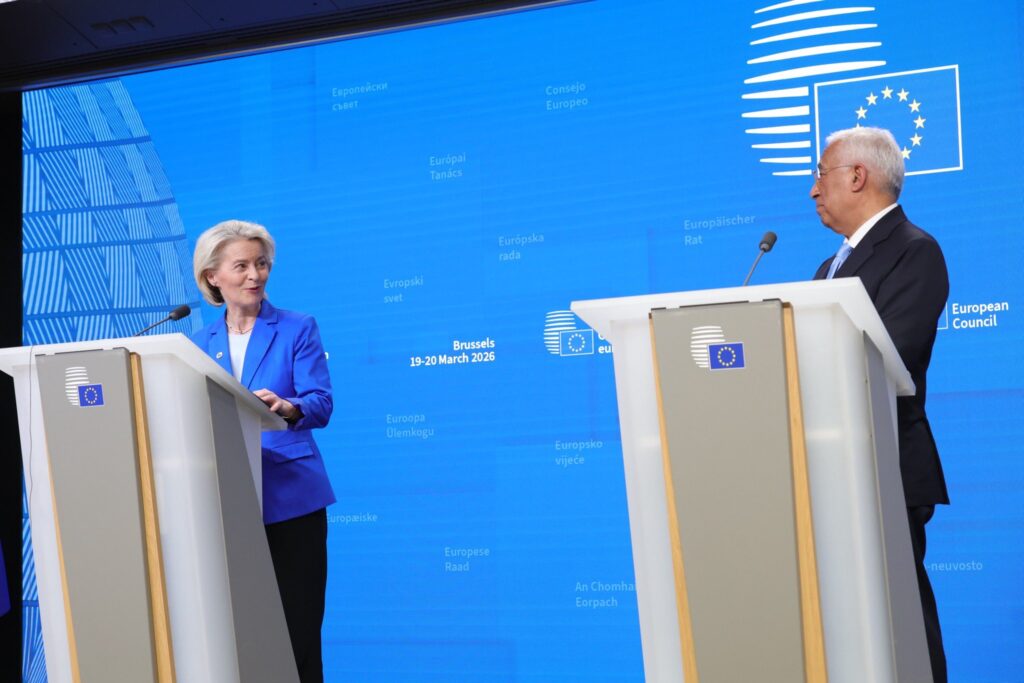
Featured image: Ursula von der Leyen via X.