



The European Commission unveiled EU-wide child safety rules on September 17, proposing the EU Kids Act that would bar children 13 and younger from holding social media accounts altogether.
Those aged 13 to 14 could hold accounts only under parental oversight, with full independent access reserved for minors 15 and older.
The proposal extends beyond social media to video platforms, online games, AI companions and chatbots, creating access rules that shift with both users’ age and the type of service involved.
To enforce age tiers, platforms would need to verify users through approved systems, including the Commission’s own certified tools, such as the European Digital Identity Wallet. Existing accounts would be checked retroactively, once the rules are enforced, and any that fall short or can’t confirm the user’s age would be outright disabled.
The Kids Act also imposes broader safety obligations on any service used by minors. AI chatbots and companions particularly would be switched off by default for anyone under 18, and children’s profiles would default to private.
Platforms face design rules, fines
The Commission also seeks for platforms to remove features that encourage compulsive use by children, including infinite scrolling, reward tricks, profiling-based feeds, and personalised advertising. It could also restrict unsolicited contact from strangers and late-night push notifications.
A 2026 study, in fact, found that platforms including AliExpress, LinkedIn, Snapchat, TikTok and Instagram use four overarching strategies to keep teenagers engaged for longer: creating social or psychological pressure to keep participating via, for example, notification badges or “streaks”; enticing users with rewards, novelty or curiosity including autoplay or infinite scroll; making it hard to disconnect including friction on exit and buried settings; and passively keeping users online without them actively deciding, through continuous feeds or ambient content that removes natural shopping points.
Platforms will be now obliged to provide parental controls and tools for blocking or reporting harmful practices and users, with large platforms being required to comply prior to offering services to children.
Companies could face fines reaching 6% of global annual sales for violations, and would also be mandated to pay supervisory fees to support continuous enforcement.
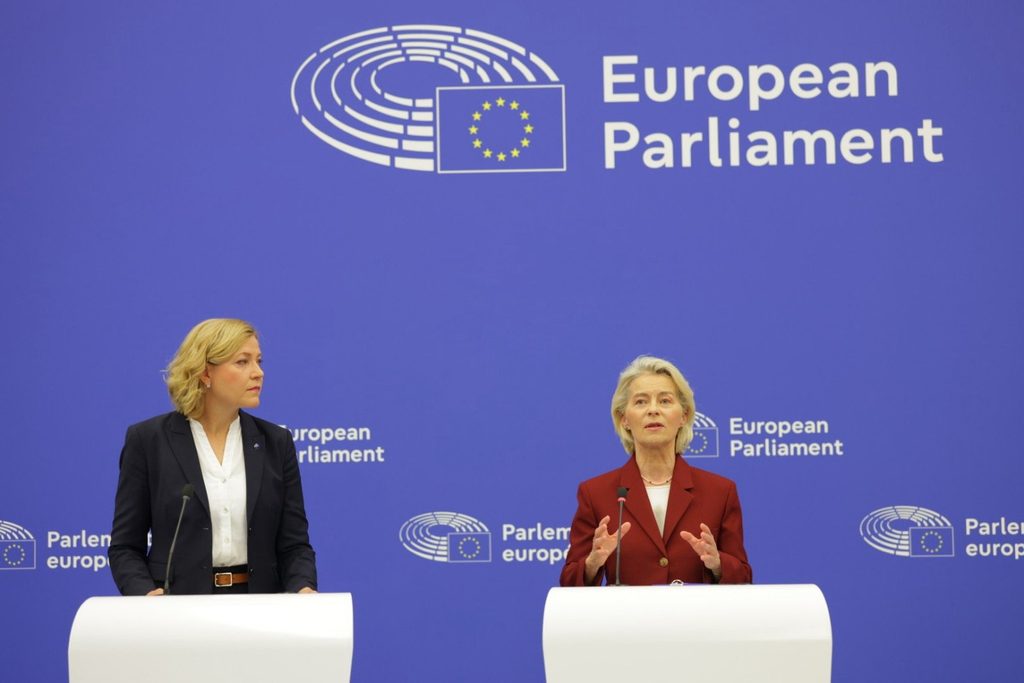
“Every day our children are engaging with some of the most sophisticated technology ever created. Technology that was not created with their wellbeing in mind. We need to set clear boundaries in the digital world,” Commission President Ursula von der Leyen said on X.
“Too many children are being exposed too early to an online world they are not ready to navigate; an environment where bullying can follow you home, where every mistake can be recorded forever. And childhood and puberty is about making mistakes and learning [from them],” she added during a press conference.
Wider privacy concerns
The proposal requires approval from EU governments and the European Parliament, meaning that negotiations could change the proposed rules before lawmakers adopt and enforce the final version.
However, the Commission seeks one EU-wide framework rather than a set of 27 country-specific rules, corresponding to its member states.
On the one hand, France has pushed for stronger social media age limits, although its own Constitutional Court blocked a national measure in April over freedom of expression concerns, as reported by French newspaper Le Monde.
Australia, meanwhile, the first country to propose such bans, has faced enforcement problems after introducing restrictions for users under 16. On September 8, the Australian government moved an amendment through federal parliament to give the eSafety Commissioner stronger powers to investigate social media platforms’ compliance.
CCIA Europe, meanwhile, raised privacy concerns about age verification and overlapping legal duties. Its head, Daniel Friedlaender, warned the system could create “an attractive target for cybercriminals.”
Further debate will therefore focus on enforcement, privacy, and platform responsibility across the bloc.
Featured image: Ursula von der Leyen via X