


Anthropic has launched Claude Science, a new AI workbench for scientists that brings research tools into one computing environment.
The beta app supports literature analysis, data workflows, figures, manuscripts and reproducible scientific outputs.
The launch marks Anthropic’s broader move into specialized research software, beyond general chatbot access.
Claude Science Brings Research Workflows Into One Place
According to the recent statement, Claude Science gives scientists a single workspace for computational research, instead of separate databases, notebooks, terminals and pipelines.
The app runs on macOS and Linux, and it also connects to remote machines through SSH and HPC login nodes. Therefore, researchers can keep sensitive datasets inside existing lab infrastructure while using Claude for selected analysis steps.
The workbench includes a coordinating assistant that manages research tasks across scientific tools and data sources. It can also create specialist agents for defined tasks, while a reviewer agent checks calculations and citations.
However, Anthropic says Claude Science is not a new biology model or a separate advanced model. The platform uses the same Claude models available through Anthropic’s current plans.
Claude Science packages those models inside a scientific workflow system. As a result, the product targets how researchers work, not only what the model can answer.
Workbench Focuses On Reproducible Scientific Outputs
Claude Science generates scientific artifacts with the code and environment used to create them.
These outputs can include protein structures, genome tracks, chemical structures, figures and manuscript drafts. In addition, each result keeps a traceable record that supports review, validation and later reuse.
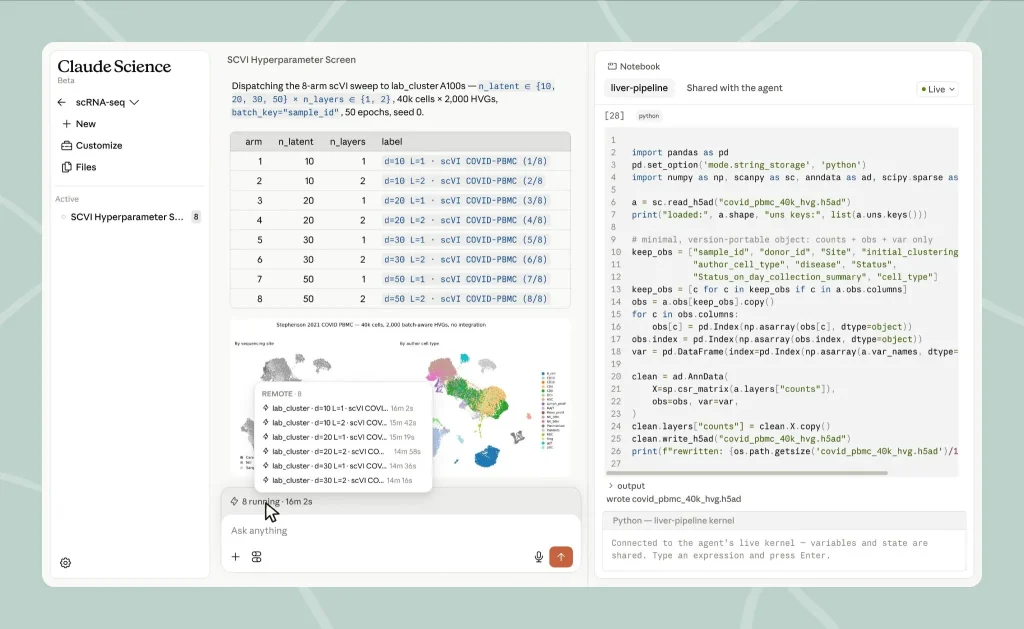
Researchers can ask Claude Science to change figures through normal language commands. The system then updates the underlying code and edits the final image. This approach helps scientists track how each visual changed and why it changed.
Anthropic also says the app can manage compute jobs across lab machines, clusters or cloud-based resources.
Claude Science drafts plans, requests approval before using new resources and submits jobs after review. Moreover, its running session keeps context in memory so that large datasets do not need repeated loading.
Anthropic Targets Scientific Teams And Research Institutions
Claude Science arrived after Anthropic expanded its life sciences work in October 2025. That earlier effort connected Claude with scientific skills, tools and partners for biology tasks. Now, the new workbench gives researchers a dedicated environment for those workflows.
Early users have applied Claude Science to single-cell RNA sequencing, CRISPR screen design, protein prediction and cheminformatics.
The Allen Institute used it for a multi-agent review workflow across large paper sets. UCSF researchers used it to support glioma germline analysis and then validated the results independently.
Claude Science is available in beta for Pro, Max, Team, and Enterprise users.
Team and Enterprise customers need admin approval before use. Anthropic also plans to support up to 50 AI for Science projects with credits and compute support.
Featured image: Screenshot of Claude Science workbench.
Image credit: Anthropic